
News · Markets · openbook · Fri, Oct 30, 2026 12:48 PM
Euro Area GDP Beats Forecasts as ECB Keeps Hike Door Open
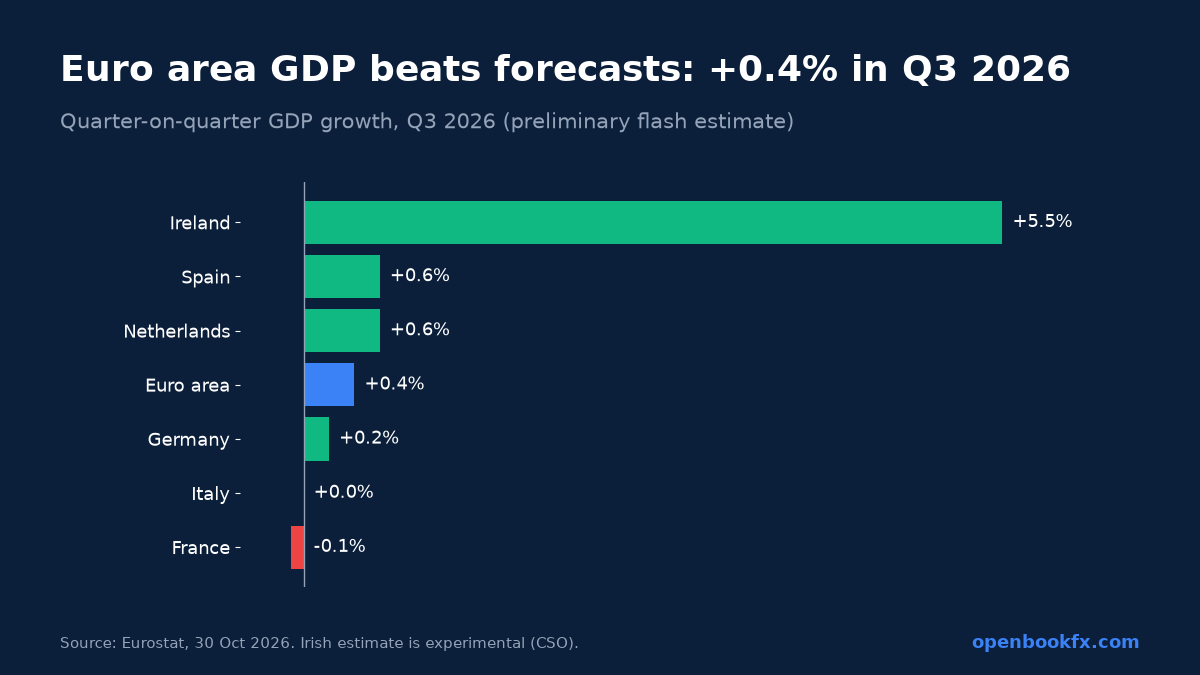
Image from the source feed · openbook
Euro area GDP grew 0.4% in Q3 2026, beating forecasts, though Ireland flattered the total.
What happened
The euro area economy grew faster than expected in the third quarter. According to Eurostat's preliminary flash estimate, seasonally adjusted GDP rose 0.4% quarter on quarter between July and September 2026, after 0.6% in the second quarter. Economists polled by Reuters had expected 0.2%, CNBC reported. Compared with a year earlier, the economy was 1.3% larger.
The figure came one day after the European Central Bank kept its deposit rate at 2.50%, following a 25 basis point hike in September. On Friday morning, Bundesbank President Joachim Nagel told Bloomberg that the ECB will take decisive action if needed to bring inflation back to its 2% target, with higher energy costs a major driver of recent price increases.
Look under the headline: Ireland and France
A single euro area number can hide very different national stories, and this quarter is a good example.
- Ireland grew 5.5% in one quarter, according to the Central Statistics Office. The jump came mainly from sectors dominated by multinationals, such as industry and information and communication. Irish GDP is famously volatile because large global companies book activity there, and the CSO itself calls this estimate experimental and subject to revision. Because of this, the Irish number lifts the euro area total more than it reflects everyday economic life in the bloc.
- France contracted by 0.1%, and Italy was flat at 0.0%.
- Germany grew 0.2%, while Spain and the Netherlands grew 0.6% each.
The lesson for readers: when a regional figure beats forecasts, check whether the beat is broad or driven by one unusual country. Here, the core economies were mixed, and the upside surprise owes a lot to Ireland.
Why it matters: the growth-versus-inflation dilemma
Central banks set interest rates by balancing growth against inflation. Stronger growth usually makes it easier to keep rates high, because the economy can absorb tighter financing conditions. The ECB's dilemma is that inflation has climbed to 3.8%, its highest since September 2023, largely because of energy prices, CNBC noted. In its statement, the ECB said the energy shock poses upside risks to inflation and downside risks to growth, while wages have not yet shown a material response.
That is why Nagel's comment drew attention. A "second-round effect" happens when higher energy prices feed into wages and other prices, making inflation stickier. Nagel said such effects have not been significant so far, but his words keep the option of another hike open. After Thursday's decision, money markets priced roughly a 67% chance of a December rate increase, according to LSEG data cited by CNBC. Better-than-expected growth makes that option easier to use, not harder.
The global backdrop: the US and Japan
The euro area is not alone in facing strong activity alongside elevated inflation.
- United States: The Bureau of Economic Analysis reported real GDP growth of 3.4% at an annualized rate in Q3, up from 2.2%. Note the convention: US GDP is annualized, so it is not directly comparable with Europe's quarterly 0.4%. The BEA says the quarterly-rate equivalent is about 0.8%. September PCE inflation, the Federal Reserve's preferred gauge, was 3.6% year on year, with core PCE at 3.1%. The Fed held its target range at 3.75%–4.00% this week.
- Bond yields: The US 10-year Treasury yield fell about 5 basis points to around 4.93% on Friday, CNBC reported, after spending much of October near or above 5%. Trading Economics linked the move to demand for safe assets during a selloff in technology shares.
- Japan: The Bank of Japan held its policy rate at 1.25% in an 8–1 vote, with one member preferring 1.5%. For the first time since 2013, it described underlying inflation as generally consistent with its 2% target.
What to watch next
- 13 November: Eurostat's second GDP estimate for Q3, which may revise today's figure.
- Euro area inflation data: whether energy-driven price increases start spreading into services and wages.
- Early December: Ireland's fuller quarterly national accounts, which could change the Irish number substantially.
- December ECB meeting: whether other Governing Council members echo Nagel's tone.
- US data and yields: how inflation and the 10-year yield evolve as global borrowing costs remain high.
The key takeaway: Europe's economy is holding up better than expected, but the surprise is uneven and partly driven by Ireland. With inflation well above target, solid growth gives the ECB more room to stay firm. This article is for educational purposes only and is not investment advice.
Read our EUR/USD guide: what moves it, the key data to watch and when it trades.
This briefing was summarized with automated tools from public reporting by openbook and is general market information, not investment advice. Editorial policy & corrections