
News · Equities · openbook · Tue, Nov 17, 2026 8:44 AM
Nasdaq Slips Into Correction as Nvidia Faces Post-Huang Test
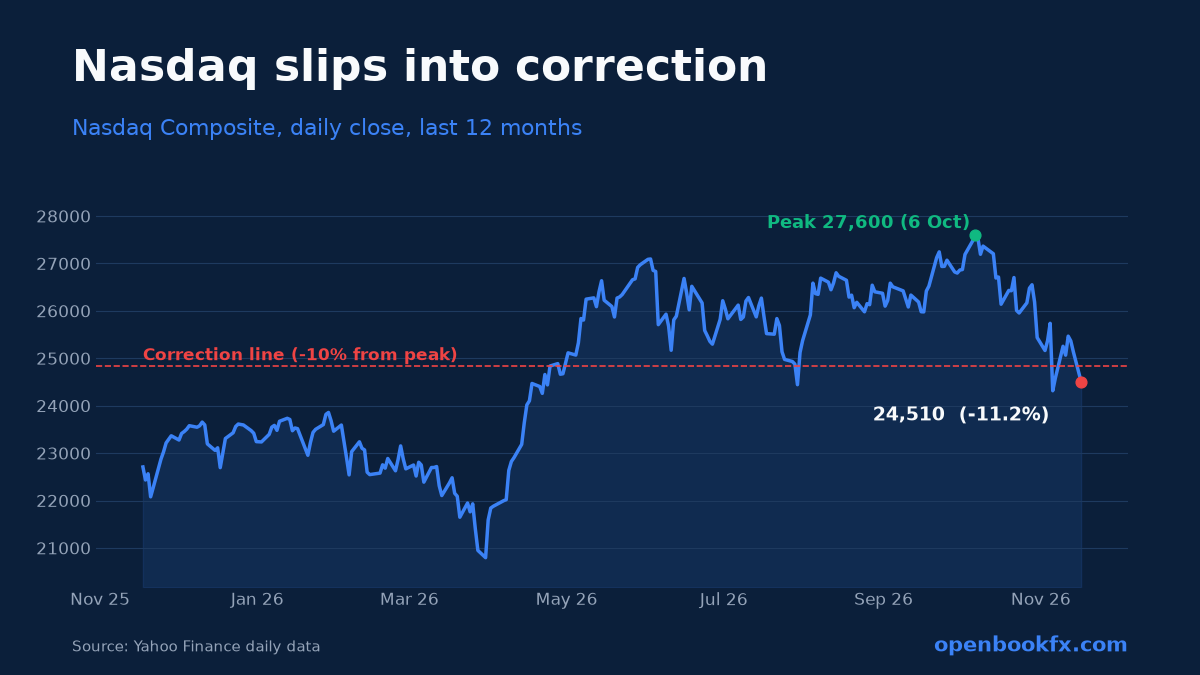
Image from the source feed · openbook
The Nasdaq fell over 10% from its October peak as AI doubts and Fed hike bets hit tech.
The Nasdaq Composite has officially slipped into correction territory. On Monday, 16 November, the tech-heavy index fell 2.49% to 24,509.76, leaving it about 11% below its record close of roughly 27,600 set on 6 October. The S&P 500 lost 1.92% to 7,416.59 and the Dow Jones fell 1.41% to 51,608.17. All of this comes on the day Nvidia, the company at the centre of the AI trade, reports its first results since founder Jensen Huang's abrupt resignation.
What happened
A correction is usually defined as a fall of more than 10% from a recent peak. The Nasdaq crossed that line after three straight losing sessions for both the Nasdaq and the S&P 500. Chipmakers led the decline: Nvidia shares fell 4.1% on Monday and the Philadelphia Semiconductor Index dropped 5.3%.
Several pressures have built up at the same time:
- Leadership shock at Nvidia. Jensen Huang resigned last Thursday. Long-time CFO Colette Kress is now interim CEO while the board searches for a permanent successor. Nvidia shares closed at about $156, roughly 35% below their October high.
- Doubts about AI spending. Investors have grown more worried about the cost of the AI infrastructure build-out, including how much of it is financed with debt. The Nasdaq had already suffered its biggest one-day drop since June on 30 October, after disappointing results from Intel and Amazon.
- Higher rates. Last week's hotter-than-expected US inflation data pushed traders to treat a Federal Reserve rate hike in December as a near certainty. The 10-year Treasury yield ended Friday at 5.15%, up from 4.86% a week earlier.
Why it matters: the usual safety nets are not working
When stocks fall sharply, investors often move money into US government bonds and gold. That pattern has broken down this month. Treasuries had their worst week since the April 2025 tariff shock even as tech shares kept falling. Spot gold touched about $3,830 an ounce on Monday, its lowest level since October 2025.
The reason is inflation. Bonds and gold tend to protect portfolios during a growth scare, when investors expect interest rates to fall. They offer much less protection when the selloff is driven by rising prices and the prospect of higher rates. Higher yields make future company profits worth less in today's money. That hits high-valuation growth stocks such as chipmakers hardest, and it also raises the opportunity cost of holding gold, which pays no interest.
The one clear winner has been the US dollar. The dollar index rose to about 103.7 on Tuesday, its highest since 2 April 2025, after five straight days of gains. The euro fell to a 19-month low near $1.0983. Risk-sensitive currencies struggled more: the New Zealand dollar dropped to its lowest since March 2020, and the Australian dollar fell to around $0.6725, a 10-month low.
Nvidia: a numbers test and a confidence test
Nvidia reports its fiscal third-quarter results after the US close on Tuesday, at around 4:20 pm New York time, with the earnings call at 5 pm. Analysts expect revenue of about $109.1 billion, around 91% higher than a year earlier, and adjusted earnings of $2.47 per share. The data-centre business is expected to bring in roughly $101.8 billion. The company's own guidance was $108 billion, plus or minus 2%.
The quarter ended in late October, before Huang left, so the figures themselves should not reflect the leadership change. What matters more is the message. Investors will listen for whether Nvidia still stands behind the roughly 70% revenue growth it pointed to for fiscal 2028, whether customer commitments and the product roadmap are unchanged, and whether there is any clarity on who will run the company. Because Nvidia is one of the largest weights in the major US indices, its results can move the whole market, not just one stock.
What to watch next
- US retail sales (Tuesday, 8:30 am ET). October sales are expected to rise 0.2% after a strong 0.8% in September, with sales excluding autos expected up 0.4%. A much stronger number could add to Fed hike bets and push yields higher. A weak one could ease rate fears but raise questions about the consumer.
- Nvidia's guidance and tone. Pay attention to the outlook for next quarter and fiscal 2028, any comments on China, and how the leadership transition is described.
- Treasury yields. If the 10-year yield keeps climbing above 5%, pressure on growth stocks and gold is likely to stay.
- Fed pricing. Markets now fully expect a December hike, while the odds of a larger half-point move have dropped to around 5%, according to CME FedWatch. Fed speakers can shift these odds quickly.
- The dollar near key levels. Watch whether EUR/USD holds around 1.10 and whether USD/JPY approaches 160, a level traders see as a possible trigger for Japanese intervention.
The bottom line
The Nasdaq's slide into correction is not only about one company. It reflects a market that has to deal with higher interest rates, rising doubts about the cost of the AI boom, and a sudden leadership vacuum at its most important stock, all at the same time. With bonds and gold failing to cushion the fall, the coming days will show whether Nvidia's numbers can steady sentiment, or whether the rate story keeps the upper hand. This article is for educational purposes only and is not investment advice.
Read our Nasdaq 100 guide: what moves it, the key data to watch and when it trades.
This briefing was summarized with automated tools from public reporting by openbook and is general market information, not investment advice. Editorial policy & corrections