
News · FX & macro · openbook · Thu, Nov 12, 2026 11:50 AM
Yen Nears 160 as Tokyo Revives Intervention Warnings
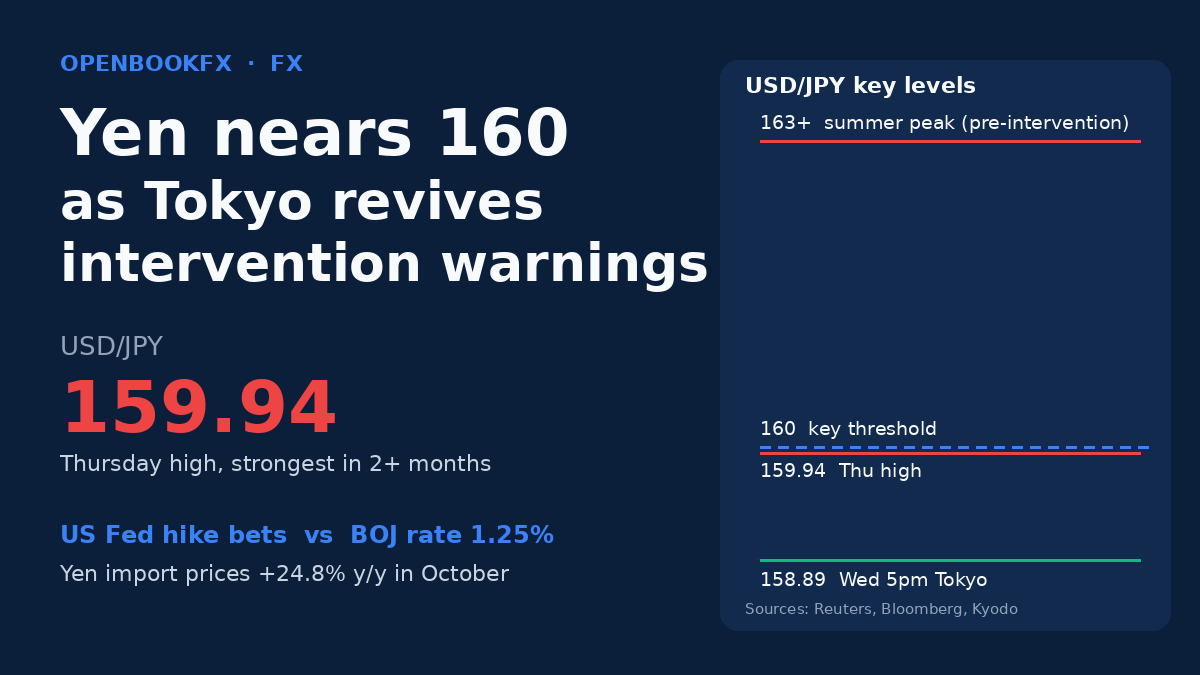
Image from the source feed · openbook
The yen slid toward 160 per dollar after hot US inflation lifted Fed hike bets.
The Japanese yen slid toward the closely watched level of 160 per US dollar this week, and Tokyo answered with its first verbal warning on currencies since late September. The dollar touched 159.94 yen early on Thursday, its strongest level in more than two months, before Japan's top currency diplomat reminded markets that this summer's intervention should not be forgotten.
What happened
The trigger came from the United States. October consumer inflation came in hotter than expected, and a string of Federal Reserve officials followed with hawkish remarks, leaving the door open even to a larger half-point move. Markets now fully price a quarter-point Fed hike in December, and some major brokerages, including Goldman Sachs, expect another one early next year. That lifted the dollar index to 103.02, its highest since April 2025.
The yen was one of the clearest casualties. It fell as much as 0.8% overnight to 159.94 per dollar, breaking out of the tight range of recent weeks. On Wednesday afternoon in Tokyo the pair had been trading near 158.9.
On Thursday, Atsushi Mimura, Japan's Vice-Finance Minister for international affairs, said he had a strong impression that moves over the past few days were "too rapid" and that it was "still too early to forget what happened this summer". He was referring to the yen-buying interventions of late July and early August, including a joint operation with the United States on July 31. The comments briefly pushed the dollar down to around 159.6 yen, but the relief did not last and the pair was back near 159.8 later in the session.
Why the yen keeps weakening
The main driver is the gap between interest rates in the two countries. The Bank of Japan raised its policy rate to 1.25% in September, but that is still well below rates in the US and Europe. When US rate expectations climb, holding dollars pays more than holding yen, and the currency tends to slip.
Two other forces are adding pressure:
- A split BOJ. Board member Toichiro Asada, one of two policymakers who voted against the September hike, said on Thursday that raising rates too early could hurt growth and push underlying inflation down. Remarks like this make investors less sure about how quickly Japan will close the rate gap.
- Fiscal worries. Part of the market is concerned about Japan's public finances as Prime Minister Sanae Takaichi pushes for more government spending, which weighs on confidence in the currency.
Why it matters
A weak yen is not just a number on a screen. Japan imports most of its energy and much of its food, so a cheaper currency makes those goods more expensive. Data released on Thursday showed the yen-based import price index jumped 24.8% in October from a year earlier, and wholesale inflation re-accelerated to 7.1% from 6.8% in September.
That puts policymakers in a difficult position. Higher import costs feed inflation, which squeezes households and can erode support for the government. Analysts at Mizuho Securities wrote that if the dollar breaks above 160 and a weaker yen fuels inflation, Tokyo could carry out unilateral intervention.
History also explains why 160 matters. Before the summer interventions, the yen had fallen beyond 163 per dollar, levels not seen in about four decades. Those operations slowed the decline but did not reverse the trend, which is why markets watch every official comment closely.
How intervention works, in simple terms
When Japan intervenes, the Ministry of Finance instructs the Bank of Japan to sell part of the country's foreign reserves, mostly dollars, and buy yen. The goal is to create sudden demand for the currency and discourage one-way bets against it. Verbal warnings, like Mimura's on Thursday, are usually the first step: officials try to slow the move with words before spending reserves. Intervention can cause sharp swings in a few minutes, but it rarely changes the direction of a currency on its own if the interest-rate gap stays wide.
What to watch next
- The 160 level. A Matsui Securities analyst said caution will "increase another notch" once the pair rises above 160. Pushing much higher would likely need a further rise in Fed hike expectations or a drop in expectations for a BOJ move.
- Fed speakers. New York Fed President John Williams is due on a panel late Thursday. Any guidance from him on the pace of hikes could move the dollar across the board.
- The December BOJ meeting. Many analysts in a Reuters poll expect the next BOJ hike as soon as next month, a view strengthened by Thursday's hot wholesale inflation figure. A hike would narrow the rate gap; a delay could keep the yen under pressure.
- Language from Tokyo. A shift from "too rapid" to stronger phrases such as "decisive action" has often been read by markets as a sign that intervention is getting closer.
The bottom line
The yen's slide toward 160 is a story about two central banks moving at different speeds. Hot US inflation has pushed Fed expectations higher, while the BOJ is still debating how fast to follow. Tokyo has started warning again, but words alone have limited effect if the rate gap keeps widening. The coming weeks, with Fed commentary and the December BOJ decision, should show whether 160 becomes a ceiling or a stepping stone.
This article is for educational purposes only and is not investment advice.
Read our USD/JPY guide: what moves it, the key data to watch and when it trades.
This briefing was summarized with automated tools from public reporting by openbook and is general market information, not investment advice. Editorial policy & corrections