News · FX & macro · openbook · Wed, Nov 11, 2026 8:04 AM
Hot CPI Revives Half-Point Fed Hike Talk as Yields Jump
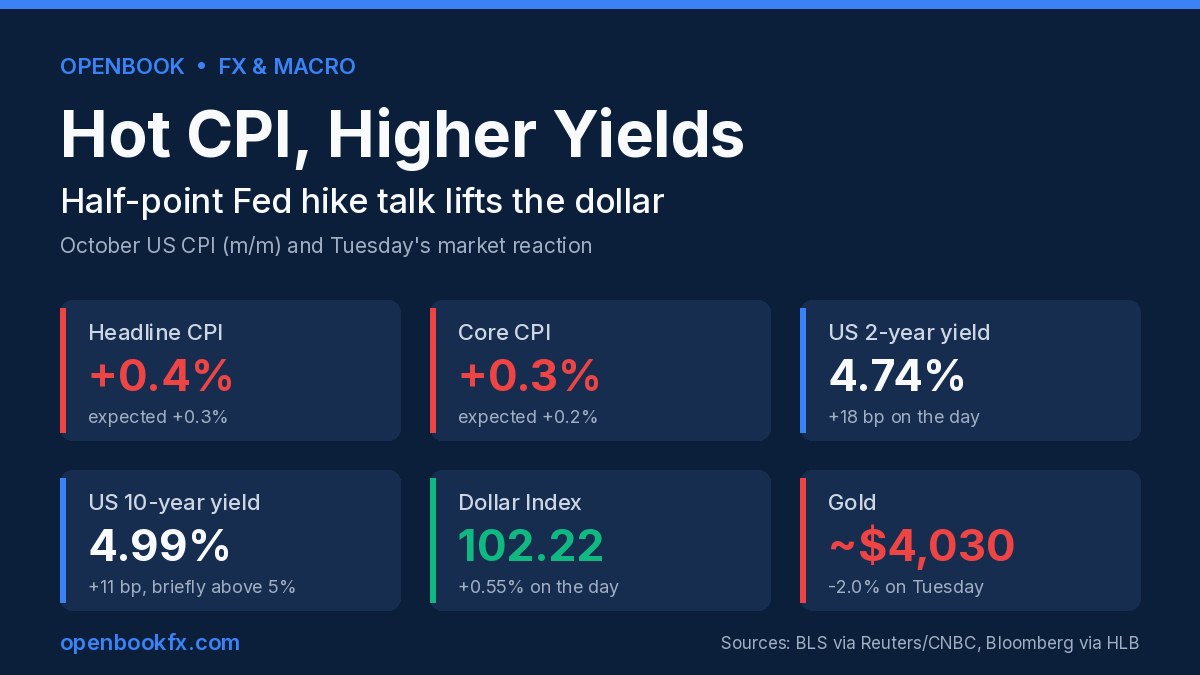
Image from the source feed · openbook
US October CPI beat forecasts and Fed's Waller floated a 50bp hike.
US inflation came in hotter than expected for October, and markets reacted quickly. The consumer price index rose 0.4% on the month, against forecasts of 0.3%. Core CPI, which leaves out food and energy, rose 0.3% against forecasts of 0.2%. Short-term Treasury yields had one of their biggest jumps in more than a year. The dollar rose against every G10 currency, and gold dropped back toward $4,000.
What the October CPI report showed
Headline consumer prices rose 0.4% in October, after 0.6% in September. That makes three months in a row with monthly gains of 0.4% or more. Core prices rose 0.3% for a third straight month. Economists had expected a slowdown.
A few details stood out in the report:
- Food prices rose 0.5%, with beef up 0.9% and snacks up 1%.
- Energy rose 0.7%, and the seasonally adjusted gasoline index was up 1%.
- Shelter rose 0.3% and made up more than 30% of the headline increase.
- Transportation services jumped 0.8%, while used car prices fell 1.2%.
One unusual detail: the Bureau of Labor Statistics did not publish a year-over-year inflation rate. Last year's government shutdown stopped it from collecting October 2025 data, so there is nothing to compare against. Before the release, economists' estimates for annual headline inflation clustered around 3.9%, up from 3.7% in September.
Why the Fed reaction mattered as much as the data
The timing made the report much more important. A few hours before it came out, Fed Governor Christopher Waller set a clear bar in a speech in London. He said he would support a 25 basis point hike at the December 8–9 meeting. But if core CPI came in at around 0.3% or higher, he said "a 50 basis point hike in the policy rate should be considered." He added that "hiking only 25 basis points would put our credibility at risk."
Core CPI came in at exactly 0.3%, which met Waller's bar. On the same day, Dallas Fed President Lorie Logan said the Fed needs at least two more quarter-point hikes, and that it may be possible to move faster this winter. She described the current 3.75%–4.00% policy rate as too low and said it was adding to inflation pressures.
According to Reuters, markets priced roughly a 15% chance of a half-point hike in December by mid-morning. That eased to about 10% by late afternoon. A 25 basis point hike in December is still fully priced. Traders also added bets on three quarter-point hikes by mid-2027, up from two before the data.
How markets moved
The bond market took the biggest hit. The 2-year Treasury yield, which closely follows expectations for Fed policy, rose about 18 basis points to 4.74%. Reuters said it was the biggest one-day rise since early April 2025. The 10-year yield briefly went above 5% and then settled near 4.99%, up about 11 basis points. A weak $42 billion note auction added to the selling.
- Dollar: The Dollar Index rose 0.55% to 102.22. EUR/USD fell to about 1.1164, GBP/USD to 1.3344 and AUD/USD to 0.6866. USD/JPY rose to about 158.75.
- Stocks: The S&P 500 fell 0.38%, the Dow fell 0.30% and the Nasdaq fell 0.74%.
- Gold: Gold fell about 2–3% on Tuesday, to near $4,017–4,030 an ounce. It recovered modestly in Asian trading on Wednesday, to around $4,040–4,060.
The link between these moves is simple. When markets expect a central bank to raise rates higher and for longer, short-term yields go up. Higher US yields make dollar assets more attractive compared with other currencies. Gold pays no interest, so it becomes less appealing when yields rise.
Why it matters beyond one data point
This report adds to evidence that US inflation is not cooling fast enough for the Fed's liking. Last week's strong October jobs data had already raised expectations of a hike. Hot inflation on top of a firm labour market leaves Fed officials with little reason to wait. For currency markets, the main question is whether US rates keep climbing faster than rates elsewhere. If they do, the dollar tends to stay supported against currencies whose central banks are moving more slowly.
A 10-year yield near 5% also matters outside trading screens. It is a benchmark for US mortgages, car loans and corporate borrowing. Higher long-term rates tighten financial conditions even before the Fed acts.
What to watch next
- Producer prices on Friday: Wholesale inflation data will show whether price pressures are building earlier in the supply chain.
- Fed speakers: Listen for whether other officials back Waller's case for a 50 basis point move, or stick with 25.
- The 5% line on the 10-year: If the yield holds above 5%, it could keep pressure on stocks and gold.
- USD/JPY near 159: The wider gap between US and Japanese rates keeps the yen under pressure.
- The December 8–9 FOMC meeting: The size of the hike, and the guidance that comes with it, will set the tone for the dollar heading into 2027.
The bottom line: October's CPI report did not change the direction markets were already expecting, but it may have changed the speed. Until inflation data cool convincingly, markets are likely to stay sensitive to every Fed comment and every new inflation figure.
This article is for educational purposes only and is not investment advice.
Read our Gold (XAU/USD) guide: what moves it, the key data to watch and when it trades.
This briefing was summarized with automated tools from public reporting by openbook and is general market information, not investment advice. Editorial policy & corrections