News · FX & macro · openbook · Mon, Nov 9, 2026 8:29 AM
Dollar Holds Gains as Jobs Data Lift Fed Hike Bets
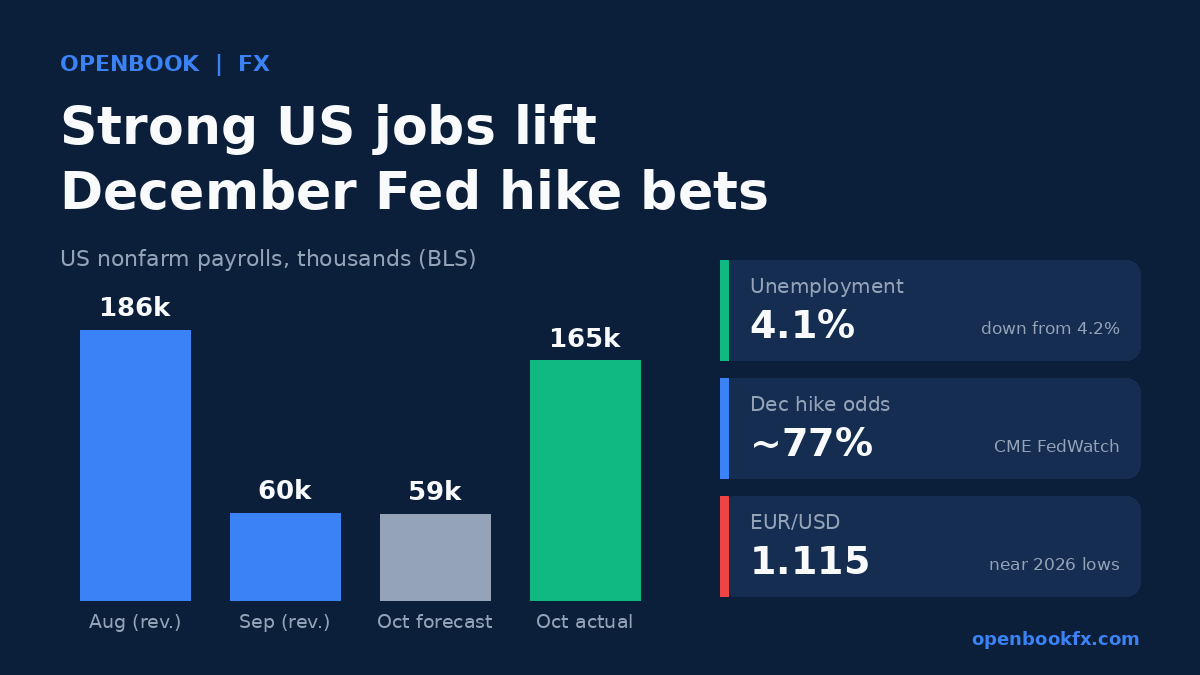
Image from the source feed · openbook
Strong US October payrolls pushed December Fed hike odds near 77% and lifted the dollar.
The US dollar started the week holding on to most of Friday's jump. The October jobs report came in far stronger than expected, and markets now see a December interest rate hike by the Federal Reserve as the most likely outcome. With US inflation data due on Tuesday, currency markets are in a waiting game, and the euro is trading close to its weakest level since May 2025.
What happened
On Friday, the US Bureau of Labor Statistics reported that the economy added 165,000 jobs in October. Economists had expected only around 59,000 to 65,000, depending on the survey. The previous two months were also revised up by a combined 84,000 jobs: August now shows a gain of 186,000 and September 60,000, instead of the 29,000 first reported.
- Unemployment rate: fell to 4.1% from 4.2%.
- Average hourly earnings: up 0.4% on the month and 3.1% on the year, above forecasts of 0.3% and 2.9%.
- Biggest gains: professional and business services (+70,000), health care (+42,000), transportation and warehousing (+25,000) and manufacturing (+19,000).
Markets reacted quickly. The US dollar index, which measures the greenback against six major currencies, rose about 0.7% on Friday to around 102.2, its biggest one-day gain in five months. The two-year Treasury yield, the part of the bond market most sensitive to Fed expectations, climbed 6 basis points to 4.52%. On Monday morning the dollar index was steady near 102.2, and EUR/USD traded around 1.115 after touching 1.1132 on Friday.
Why the jobs report matters for the Fed
The Fed raised its benchmark rate in September and then held it at 3.75% to 4% on 28 October. Since then, Chair Kevin Warsh has kept the door open to further hikes while inflation stays above the 2% target. The question for markets was whether the economy was strong enough to handle more tightening.
Friday's numbers gave a clearer answer. According to the CME FedWatch tool, the probability of a quarter-point hike at the 8–9 December meeting rose to about 77% after the data, up from roughly 67% a day earlier. Earlier in the week, a sharp sell-off in technology stocks after the US midterm elections had pushed those odds lower, as investors worried that slower AI investment could cool the economy. The jobs report reversed much of that move.
Wages are a key part of the story. Faster pay growth can feed into prices, especially in services, which is exactly what the Fed wants to avoid. Higher energy costs linked to the Middle East conflict add to that concern, even though oil has fallen sharply in recent days.
Why the dollar reacts
Currencies tend to follow interest rate expectations. When markets expect US rates to rise relative to rates in Europe or Japan, holding dollars becomes more attractive, and the dollar usually strengthens. That is why a single data release about American jobs can move EUR/USD, USD/JPY and even gold.
Not every currency followed the same script on Monday, though. The New Zealand dollar rose about 0.7% to near 0.5585 after a close national election, and the yen was slightly firmer around 158.2 per dollar. Gold, which often weakens when the dollar and yields rise, bounced more than 1% to around $4,130 an ounce after Friday's drop, helped by a softer dollar and lower oil prices.
What to watch this week
- US CPI (Tuesday, 14:30 CET): the consumer inflation report is now the main event. A hot reading would strengthen the case for a December hike; a softer one could bring the odds back down and ease pressure on the euro.
- US PPI (Friday): producer prices give an early hint of cost pressures moving through the economy.
- EUR/USD near 1.11: the pair is close to its lows of the past week, around 1.1105. Markets will watch whether that area holds after the inflation data.
- Fed speakers: any comments on how much weight officials give to the jobs report versus inflation will be closely read.
- Oil prices: Brent has fallen to around $97 a barrel after its steepest weekly drop since 2020. Lower energy prices could take some pressure off inflation in the coming months.
The bottom line
A strong labour market gives the Fed room to keep tightening, and markets have moved to price that in. The dollar has gained as a result, but the next step depends on inflation. Tuesday's CPI report will show whether Friday's move was the start of a new trend or a reaction that fades once the price data is in. For anyone following FX, this is a good week to see how closely currencies track central bank expectations.
Read our EUR/USD guide: what moves it, the key data to watch and when it trades.
This briefing was summarized with automated tools from public reporting by openbook and is general market information, not investment advice. Editorial policy & corrections