
News · FX & macro · openbook · Tue, Nov 10, 2026 8:54 AM
US CPI Day: How Much More Can Markets Price In?
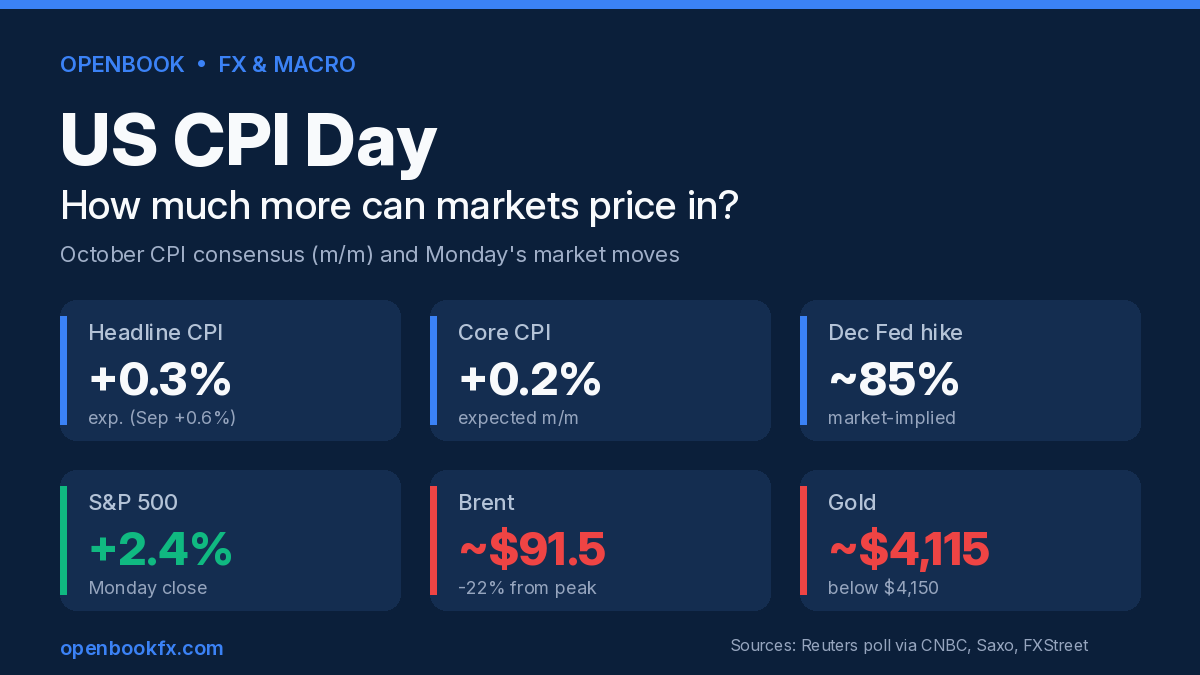
Image from the source feed · openbook
October US CPI lands with a December Fed hike largely priced in.
Tuesday is inflation day in the United States. The October consumer price index (CPI) is due at 13:30 GMT, and it arrives at a sensitive moment: markets have just bounced back from a sharp sell-off, oil prices are falling fast, and traders already see a Federal Reserve rate hike in December as very likely. The question is no longer whether inflation matters, but how much more the market can price in.
What happened
Monday was a strong day for risk assets. According to Saxo Bank, the S&P 500 rose 2.4% to 7,549.94, the Nasdaq 100 jumped 3.4% and the Dow gained 2.2%, Wall Street's best session since April. Europe followed, with the Stoxx Europe 600 up 1.3% and the DAX up 1.7%, and Asia joined in on Tuesday as Japan's Nikkei 225 closed 2.9% higher above 60,000.
The main driver was oil. Brent crude has fallen about 22% from its late-October peak above $117 and traded near $91.50 on Tuesday, as hopes grew for an agreement that could end the conflict in the Middle East. Lower energy prices ease fears that inflation will keep climbing, and that helped equities recover.
In currencies, the move was more modest. The euro rose about 0.7% to around $1.1220, reversing Friday's drop after the strong US jobs report, and the Australian dollar climbed back to about $0.6921. The Japanese yen stayed near 158 per dollar. Gold touched a three-week high near $4,150 before slipping back toward $4,115 ahead of the data.
What the market expects from CPI
This release is unusual. Because of the 2025 government shutdown, the Bureau of Labor Statistics will publish only the index level and the month-on-month changes this time. That puts the focus on the monthly numbers:
- Headline CPI: expected to rise 0.3% in October, a clear slowdown from 0.6% in September.
- Core CPI (excluding food and energy): expected to rise 0.2%.
- Year-on-year estimates: economists polled by Reuters see headline inflation near 3.9% and core near 2.8%.
Core inflation will probably get more attention than usual. Energy prices have been swinging heavily with the conflict, so core figures give a cleaner picture of underlying price pressure.
Why it matters
Earlier this year, markets expected the Fed to cut rates. That view flipped as the war pushed energy prices higher and inflation picked up. After Friday's October jobs report, which showed hiring more than twice what economists expected, markets now price roughly an 85% chance of a rate increase at the Fed's December 8–9 meeting, and about two hikes by the middle of next year.
That creates an asymmetric setup. A Westpac strategist quoted by CNBC noted that there is only a little more room to price in for December, but expectations for later meetings could still rise. In simple terms:
- A hotter reading would mostly push up expectations for 2027 hikes. That tends to support the dollar and Treasury yields, and it usually weighs on gold, which pays no interest.
- A cooler reading, especially in core prices, could make investors question whether the Fed needs to tighten much after December. That could weaken the dollar and give gold and equities more room.
Bond markets are already sensitive. The 2-year Treasury yield, which tracks Fed expectations closely, rose about five basis points on Monday to near 4.56%, while the 10-year yield traded near 4.88%.
The oil factor
There is a timing issue to keep in mind. October's CPI reflects prices from last month, when oil was still close to its highs. The sharp drop in crude since late October will only show up in later reports. So even a firm October number does not necessarily mean inflation pressure is building from here. Markets will try to judge whether price gains are spreading beyond energy, into services, rents and everyday goods.
How calm is the market?
Volatility has dropped quickly. Saxo noted that the VIX index, often called Wall Street's fear gauge, fell 22% on Monday to 19.92. Options pricing implied a move of about 0.79% in the S&P 500 on CPI day, which suggests traders see the report as an important but ordinary event, not a second shock after last week's sell-off.
What to watch
- Core CPI versus 0.2%: the cleanest sign of underlying inflation in this shortened release.
- The 2-year Treasury yield: the quickest read on how Fed expectations change after the data.
- EUR/USD around $1.12: the pair sits near the middle of the range it has held for about a month.
- Gold near $4,150–$4,170: an area where buyers have struggled several times recently.
- Fed speakers and the 10-year auction: Fed comments and a 10-year Treasury note auction later on Tuesday can add to the reaction. The US bond market is closed on Wednesday.
- Oil headlines: any news on talks between Washington and Tehran can quickly change the inflation outlook.
The bottom line
Markets go into the October CPI with a December Fed hike largely priced in. That means the report is less about next month and more about how far the tightening cycle might go in 2027. With oil falling, a soft core number could cool those expectations, while a firm one would remind investors that inflation is not only about energy.
This article is for educational purposes only and is not investment advice.
Read our Gold (XAU/USD) guide: what moves it, the key data to watch and when it trades.
This briefing was summarized with automated tools from public reporting by openbook and is general market information, not investment advice. Editorial policy & corrections