
News · FX & macro · openbook · Mon, Nov 16, 2026 9:06 AM
Euro Slides Toward 1.10 as Fed Hike Bets Lift the Dollar
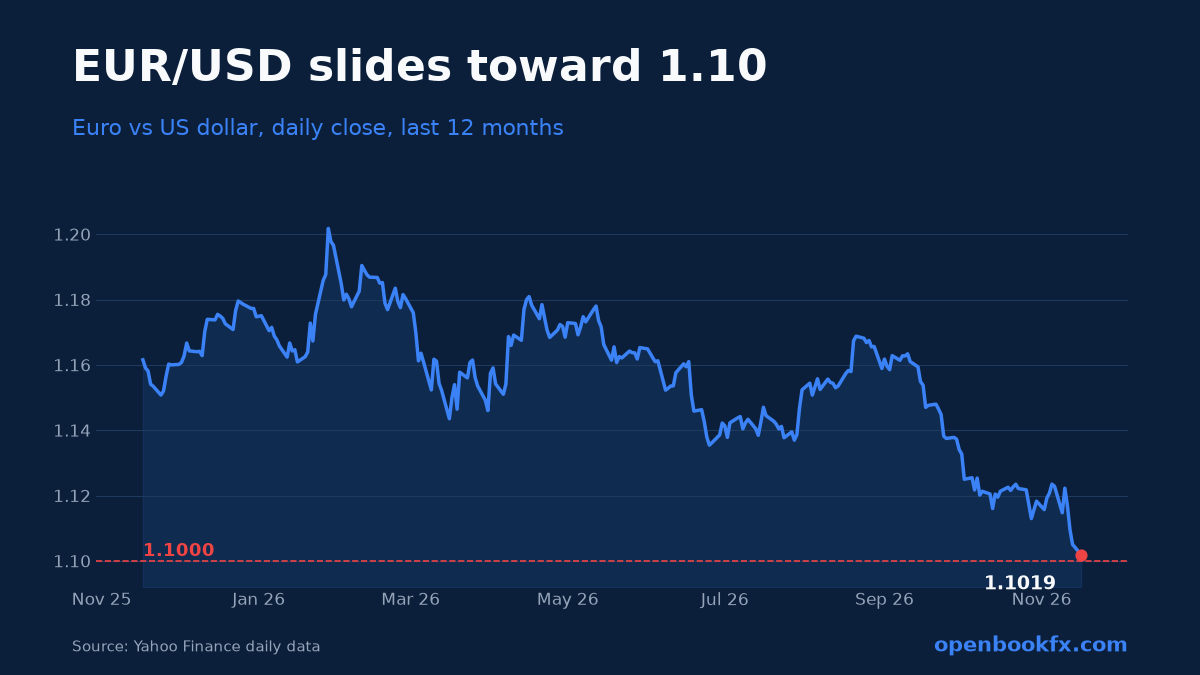
Image from the source feed · openbook
EUR/USD hit a 19-month low near 1.10 as hot US inflation and Fed hike bets lifted the dollar.
The euro started the new week at its weakest level against the US dollar in about 19 months. EUR/USD dipped to around 1.1009 early on Monday, 16 November, after closing Friday's session near 1.1050 and touching a low of 1.1023. The pair has now fallen for four weeks in a row, and the round number of 1.1000, a level it has not closed below since April 2025, is suddenly within reach. Back in late January the euro was trading close to 1.20, so the move over the past ten months has been large for a major currency pair.
What happened
The main story is not a crisis in Europe but strength in the dollar. The US Dollar Index (DXY), which measures the dollar against a basket of major currencies, rose 0.2% on Friday to about 103.41, its strongest weekly gain in two months, and pushed to roughly 103.49 on Monday, a 19-month high.
Three things fed that move:
- Hot US inflation. October consumer prices came in above expectations for the third month in a row, and producer prices rose 6.5% from a year earlier. Core inflation, which strips out food and energy, also beat forecasts.
- A more hawkish Federal Reserve. Markets now treat a quarter-point hike at the Fed's 8–9 December meeting as the most likely outcome, which would take the target range above its current 3.75%–4.00%. Over the weekend, Kansas City Fed President Jeffrey Schmid said inflation was "moving in the wrong direction", and Boston Fed President Susan Collins backed gradual increases. Treasury Secretary Scott Bessent, by contrast, warned against tightening too much.
- Higher US yields. The 10-year Treasury yield ended Friday around 5.13%, and the 2-year near 4.84%. Higher yields make dollar assets more attractive to global investors.
Why the euro is losing the rate race
The European Central Bank is also tightening. Most economists polled by Reuters expect the ECB to raise its deposit rate to 2.75% in December, and more than a third see another move in early 2027, with euro area inflation running at about twice the 2% target. German 10-year yields rose about 12 basis points last week to roughly 3.38%.
So why is the euro still falling? Currencies tend to follow the gap between interest rates, not just their direction. US rates are higher and, crucially, markets believe the Fed will keep hiking for longer. Analysts at ING put it simply: the market sees "a prolonged tightening cycle as more credible in the US than in the eurozone". They note that short-dated EUR/USD swap differentials, a measure of the expected rate gap, have widened to the largest levels of the year.
There is also a growth angle. Part of Europe's inflation comes from energy costs linked to the conflict in the Middle East, and that is a burden for the economy rather than a sign of strong demand. ECB policymaker Philip Lane has said future decisions will depend on how strongly the recent fuel price surge spreads into wages and other prices. That cautious tone contrasts with Fed speakers openly discussing larger hikes.
Why it matters
A weaker euro has real effects beyond trading screens:
- Imported inflation in Europe. Oil and many commodities are priced in dollars. A cheaper euro makes them more expensive for European buyers, which can keep inflation high and put more pressure on the ECB.
- Exporters and tourists. European exporters become more competitive abroad, while Europeans travelling to the US or buying US goods pay more.
- Global spillovers. The dollar's strength is broad. Sterling slipped to about 1.3192, a one-month low, even though the Bank of England raised rates to 4% in November and its chief economist Huw Pill says more hikes are likely in 2027. Gold has also struggled as real yields rise.
Round numbers like 1.1000 matter mainly because many market participants watch them. They often act as psychological reference points where buying or selling interest gathers, and a clear break can change how investors talk about the trend.
If you follow the euro against the dollar, our forex broker guide explains what to check on regulation, spreads and leverage.
What to watch next
- Fed Chair Kevin Warsh's comments later on Monday, for any hint about the size and pace of future hikes.
- US retail sales for October on Tuesday. Strong spending would support the case for higher rates; a weak number could cool the dollar's rally.
- FOMC minutes on Wednesday. They predate the latest inflation data, but they will show how many officials were already leaning toward more tightening.
- ECB speakers. A noticeably more hawkish tone, or talk of hikes well into 2027, would be one of the few things that could narrow the rate gap.
- Risk sentiment. Big events such as Nvidia's earnings this week, or any geopolitical breakthrough in the Middle East or Ukraine, can shift flows into or out of the dollar quickly.
Some analysts note that the dollar index is approaching technically overbought territory, which means short-term pauses are always possible. But as long as US inflation keeps surprising on the upside and the Fed sounds more determined than the ECB, the interest rate gap remains the key force behind EUR/USD.
This article is for educational purposes only and is not investment advice.
Read our EUR/USD guide: what moves it, the key data to watch and when it trades.
This briefing was summarized with automated tools from public reporting by openbook and is general market information, not investment advice. Editorial policy & corrections