News · FX & macro · openbook · Mon, Nov 2, 2026 8:29 AM
Rate Hikes Return: RBA, BoE and US Jobs Set the Week's Tone
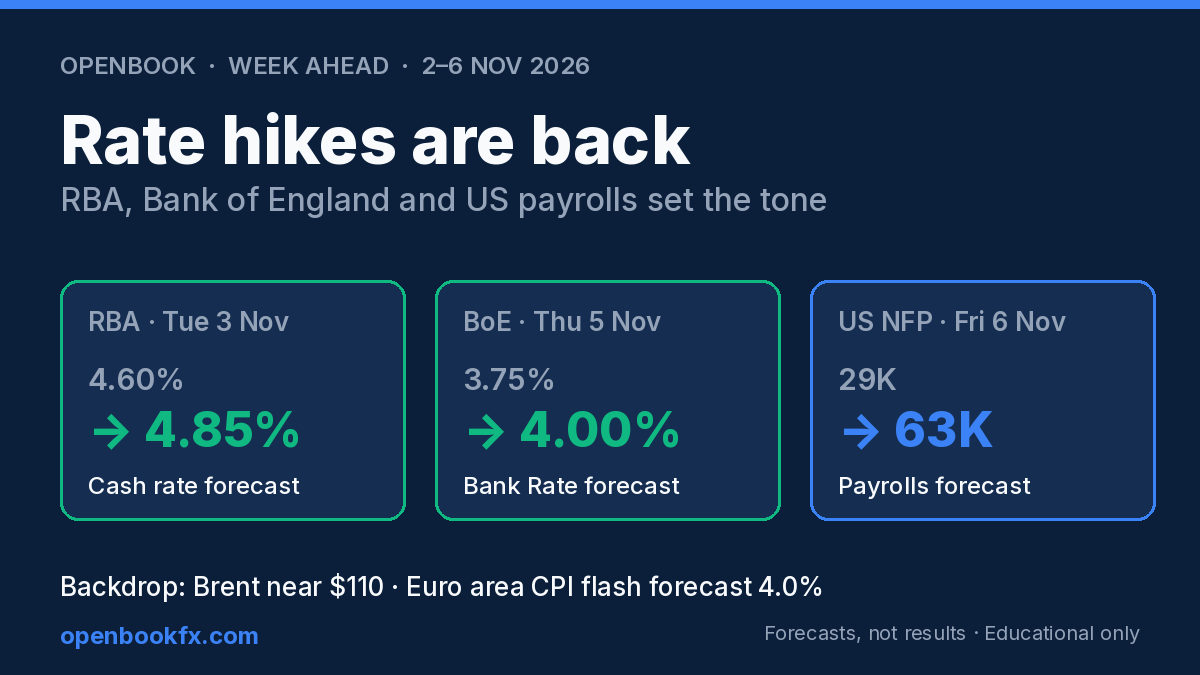
Image from the source feed · openbook
Australia and the UK are expected to raise rates this week, and US payrolls close it out.
What is happening this week
After a quiet stretch for central banks, interest rate hikes are back on the calendar. Between Monday 2 and Friday 6 November 2026, two major central banks are expected to raise rates, and the week ends with the US jobs report. According to the consensus calendar compiled from ForexFactory data, the forecasts are:
- Reserve Bank of Australia (Tuesday 3 Nov, 03:30 UTC): cash rate forecast at 4.85%, up from 4.60%.
- Bank of England (Thursday 5 Nov, 12:00 UTC): Bank Rate forecast at 4.00%, up from 3.75%, with a forecast vote split of 7-0-2.
- US non-farm payrolls (Friday 6 Nov, 13:30 UTC): forecast at +63,000 jobs after +29,000, with unemployment steady at 4.2%.
There is also politics. The US midterm elections take place on Tuesday, and CNBC reports that investors expect the vote to matter less than earnings and the AI trade. On Friday the Nasdaq 100 fell 3.5%, its worst day since June, and the Philadelphia Semiconductor Index dropped 7.2%, Bloomberg noted. US futures pointed higher on Monday morning.
Why rates are rising again: the oil backdrop
The common thread is energy. Brent crude traded around $110 a barrel on Monday, even after a 2.9% fall on reports that the US wants to give diplomacy with Iran more time. When oil stays this high, it pushes up transport, heating and production costs, and that feeds into consumer prices. Central banks then face a hard choice: raise rates to stop inflation from spreading, or hold back because high energy costs already slow the economy.
In the euro area, the flash estimate of headline inflation on Wednesday is forecast at 4.0% year on year, up from 3.8%, while core inflation, which excludes energy and food, is seen steady at 2.5%. That gap is a useful clue: it suggests the price pressure is still mostly coming from energy rather than from the wider economy.
How rate decisions move currencies
A simple rule helps here. Money tends to flow toward the currency that offers a higher yield, so higher interest rates can support a currency. But markets price in what they expect in advance. If everyone already expects a hike, the hike itself often changes little. What moves the currency is the surprise and the guidance about what comes next.
- A "hawkish hike" means the bank raises rates and hints at more. That usually supports the currency.
- A "dovish hike" means the bank raises rates but suggests it may stop there. The currency can fall even though rates went up.
- No hike when one was expected is a clear surprise and usually weakens the currency.
For the Bank of England, the vote split is worth watching as closely as the decision. At the previous meeting the calendar shows a 3-0-6 split; a forecast of 7-0-2 would mean a big shift in the committee toward hiking. If fewer members vote for a hike than expected, that alone could weigh on GBP/USD. For the RBA, AUD/USD usually reacts within minutes of the 03:30 UTC statement, and the press conference an hour later can change the first move.
The US jobs report: one number, many readings
Friday's payrolls report sets the tone for the US dollar. A stronger number than the 63,000 forecast would suggest the US economy is holding up, which can lift Treasury yields and the dollar. A weak number would do the opposite. Two details often matter as much as the headline:
- Average hourly earnings, forecast at +0.3% for the month after +0.1%. Faster wage growth can keep inflation sticky.
- Revisions to earlier months. A weak headline with upward revisions can be read as positive, and the reverse is also true.
Earlier in the week, the ISM manufacturing index (Monday, forecast 54.7) and ISM services index (Wednesday, forecast 54.9) give early hints about activity. Readings above 50 mean the sector is expanding.
What it means for stocks and gold
Equity markets enter the week nervous. According to CNBC, 138 S&P 500 companies report results this week, including Apple and Palantir on Monday and AMD on Tuesday. Weak free cash flow at several large technology companies has raised questions about how much they are spending on AI. Higher rates make that worry sharper, because they raise borrowing costs and make future profits look less valuable today.
Gold sits between these forces. Higher rates and a stronger dollar tend to weigh on it, while political uncertainty and energy-driven inflation can increase demand for it as a store of value. That is why gold can move in both directions during a week like this one.
What to watch
- Tuesday 3 Nov: RBA decision and press conference, US midterm elections, US JOLTS job openings (forecast 7.11 million).
- Wednesday 4 Nov: euro area flash inflation (forecast 4.0%) and US ISM services.
- Thursday 5 Nov: Bank of England decision, vote split and Monetary Policy Report, with Governor Bailey speaking at 12:30 UTC.
- Friday 6 Nov: US jobs report and Canada's employment data, both at 13:30 UTC.
- All week: oil prices and any news on US-Iran diplomacy, which feed directly into inflation expectations.
Forecasts are expectations, not results. Actual decisions and data can differ, and prices can move quickly around release times. Follow live rates on our markets page and read our guides to understand how each release works. This article is educational and is not investment advice.
Read our GBP/USD guide: what moves it, the key data to watch and when it trades.
This briefing was summarized with automated tools from public reporting by openbook and is general market information, not investment advice. Editorial policy & corrections